
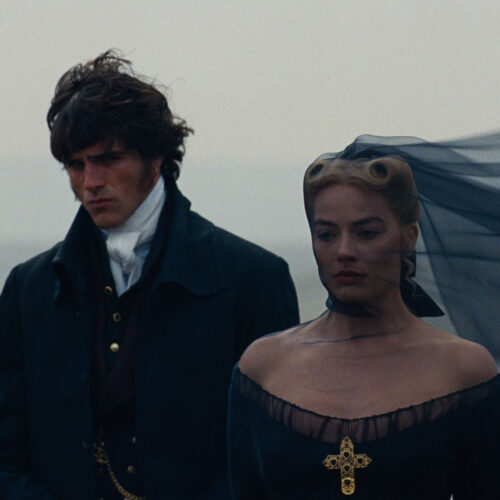
Margot Robbie plays Catherine ‘Cathy’ Earnshaw alongside Jacob Elordi as Heathcliff in Emerald Fennell’s take on Emily Brontë’s classic.
Emerald Fennell’s take on Emily Brontë’s classic novel Wuthering Heights has been controversial ever since it was announced, and now the film itself is here, expect to witness plenty of heated debates and outrage about it!
Similar to the 1847 novel, “Wuthering Heights” – with deliberate quotation marks – follows Catherine Earnshaw, who is raised by her alcoholic father (Martin Clunes) alongside a young boy named Heathcliff, whom he informally adopted.
Cathy and Heathcliff (played by Charlotte Mellington and Owen Cooper at the start) love each other deeply and assume that they will end up together.
But reality hits them as adults (now Margot Robbie and Jacob Elordi) when Cathy realises that she will have a better life with her wealthy neighbour Edgar Linton (Shazad Latif), even though she loves Heathcliff.
Angered by her accepting Linton’s proposal, Heathcliff leaves the Yorkshire Moors and doesn’t return for years.
When he makes his grand comeback, he is now mysteriously wealthy and dressed like a gentleman, and Cathy’s commitment to Linton is tested by Heathcliff’s presence and their mutual obsession and possessiveness.
Fans of the classic novel may not be happy with this adaptation because it tells only a small portion of the story, removes characters and may feel incomplete.
However, Fennell has made it clear that this is her interpretation of the story based on her experience reading it for the first time when she was 14.
It was never going to be a loyal adaptation and people should not go into the film expecting such.
Those who go in with an open mind will find plenty to enjoy, from the bold, colourful and inventive costume and set designs (although they are historically inaccurate), the score and the beautiful cinematography.
But unfortunately, it is a classic case of style over substance. It is aesthetically sensational but narratively lacking, unable to reach the emotional depth it’s striving for.
It’s not completely emotionally hollow, because certain scenes achieve the right register (such as the final act), but others fall a bit flat.
“Wuthering Heights” has been widely marketed as a raunchy, sexed-up version of the book, but it’s not as saucy as you’ve been led to believe. There are sex scenes but these are tame, unremarkable and feature no nudity.
The eroticism comes more from the sexual tension and looks of yearning and lust, which Elordi does more effectively than Robbie, and the weird, provocative imagery.
Robbie is not completely convincing as Cathy and can’t match Elordi’s smouldering looks of passion, burning desire and hatred. She does well with testing him and defying him, trying to make him vulnerable, but she isn’t fully believable when she says she loves him.
The support cast shines the most, from Hong Chau as Cathy’s maid Nelly Dean and Alison Oliver as Linton’s sweet ward Isabella. She steals every scene she’s in and is surprisingly very funny.
“Wuthering Heights” is not perfect, but it’s also not the complete disaster some have proclaimed it to be. It is a technical, visual triumph and Fennell has once again created a provocative film that will get people talking.
However, this is weaker than Promising Young Woman and Saltburn, and perhaps she is better suited to telling original stories.
In cinemas from Friday 13th February
By Hannah Wales
© Cover Media